
Dustless Floor Refinishing in BaltimoreWhat “dustless” really means — and what it doesn’t
Every refinisher advertises dustless. Here's the honest version: it means dust-contained — captured at the machine and kept out of the rest of your house — not a promise of zero dust. That difference matters when you're living in the home while the work happens.
How dust containment actually works
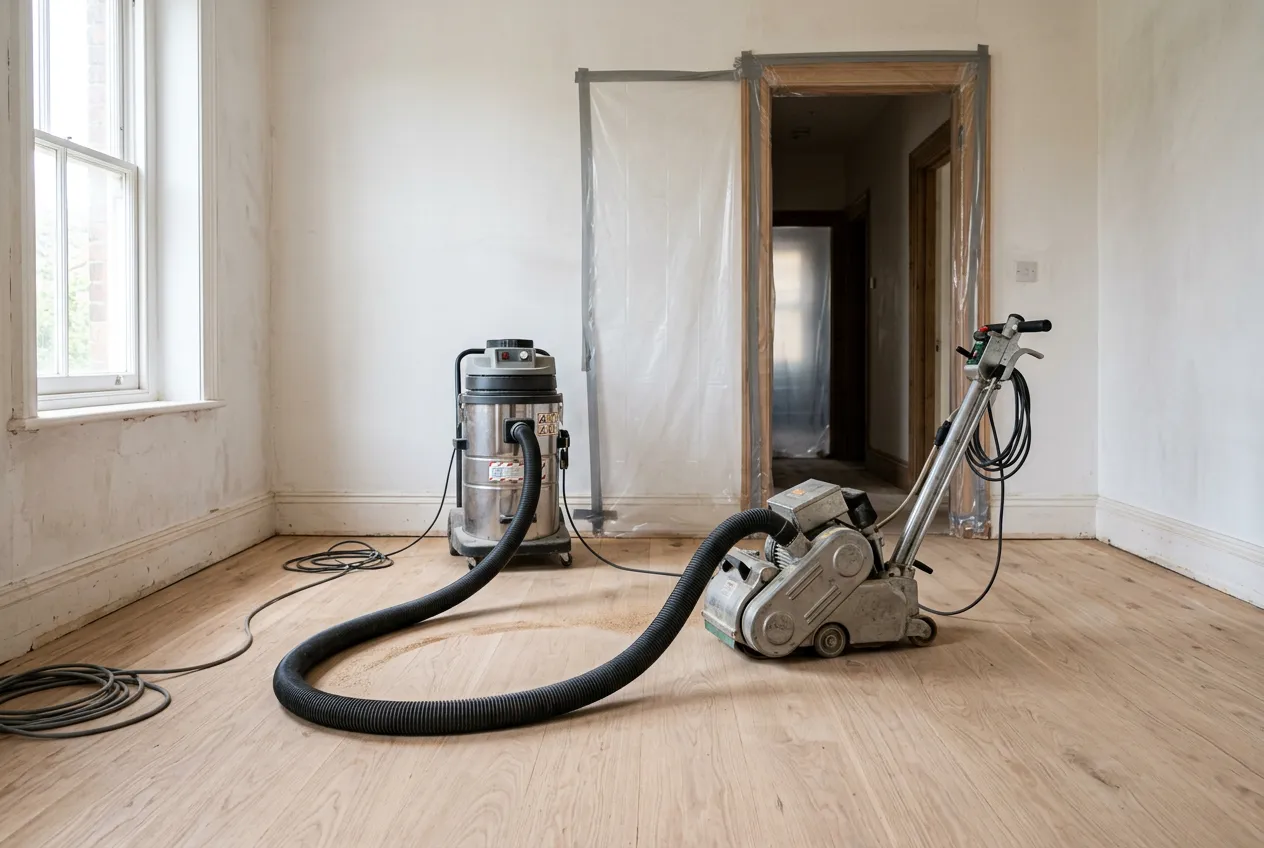
Two things do the job. First, vacuum extraction at the machines themselves: the drum sander and edger are connected by hose to a high-powered vacuum, so dust is pulled away at the exact point the abrasive meets the wood — before it ever reaches the air. That’s the opposite of the old approach, where the machine flung dust into a cloth bag and the room, and it’s where the “dustless” name comes from. Second, containment: doorways to the rest of the house sealed with plastic sheeting, floor registers covered so fine dust can’t ride the ductwork into other rooms, and the HVAC fan off while machines are cutting. Capture at the source, plus a sealed perimeter for whatever escapes.
The honest part: contained is not zero
No vacuum captures every particle. The edger works into corners and along baseboards where extraction is hardest, hand-scraping in tight spots makes dust with no machine attached to it, and some fine powder settles inside the work area no matter what. So the truthful claim is this: the rooms being sanded will need a wipe-down at the end, and the rest of your house shouldn’t. It is not surgery-clean, and anyone promising literally zero dust is selling the word rather than the method. What containment eliminates is the old horror story — a film of oak dust on every bookshelf, in every closet, two floors away, for months.
What it means for living in the house
This is where containment earns its keep, especially in a rowhome where there’s no way to put thirty feet between you and the work. With the work area sealed, the kitchen and bathrooms stay usable, beds don’t need shrouding, and closets can stay closed instead of emptied. Baltimore’s narrow row-house layouts actually help here — long and room-by-room rather than open-plan, so a floor or a front room can be sealed off cleanly while the rest of the house carries on. You’ll still hear the machines, you’ll smell finish on coating days, and the sanded rooms are off-limits until the finish cures. But you’re cleaning one work zone afterward, not the whole house.
How the days actually run
The rhythm is the same in most occupied homes. The first day is prep and heavy cutting: doorways sheeted, registers taped over, the coarse passes that make most of the dust — all of it with the vacuums running. The following passes are finer and progressively cleaner. Then the character of the job changes: coating days are quiet, but the fresh finish is exactly when airborne dust is the enemy, so the containment stays up and traffic through the space stops entirely. Between coats the surface gets a light abrasion and a careful vacuum-and-tack so each new coat goes onto a clean one. The sheeting comes down last, after the final coat has had its initial cure — taking it down early just invites the household’s ordinary dust to land in your brand-new finish. Pets and kids should stay out of the work zone for the duration; everything on the other side of the plastic is normal life.
Same craft underneath, better containment around it
Dustless refinishing isn’t a different service — it’s how a proper refinish should run in an occupied home. The sanding itself follows the same grit stages and the same drum-and-edger sequence whether or not a vacuum is attached; containment changes what happens to the dust, not what happens to the wood. It also matters for the finish quality itself: dust floating in the air while a coat is drying lands in it and leaves grit you can feel underfoot, so the cleaner the air, the smoother the final surface. If you’re weighing up what a dust-contained refinish would run for your rooms, the cost calculator will get you a realistic figure from your square footage in under a minute.
Planning to stay home during the work?
Tell us which rooms are being done and how the house is laid out, and you’ll get a straight answer on what stays usable, what gets sealed, and how the days actually run.
Worried about the mess more than the floor?
Fair. Ask exactly how containment works in your layout — you'll get specifics, not a slogan.